
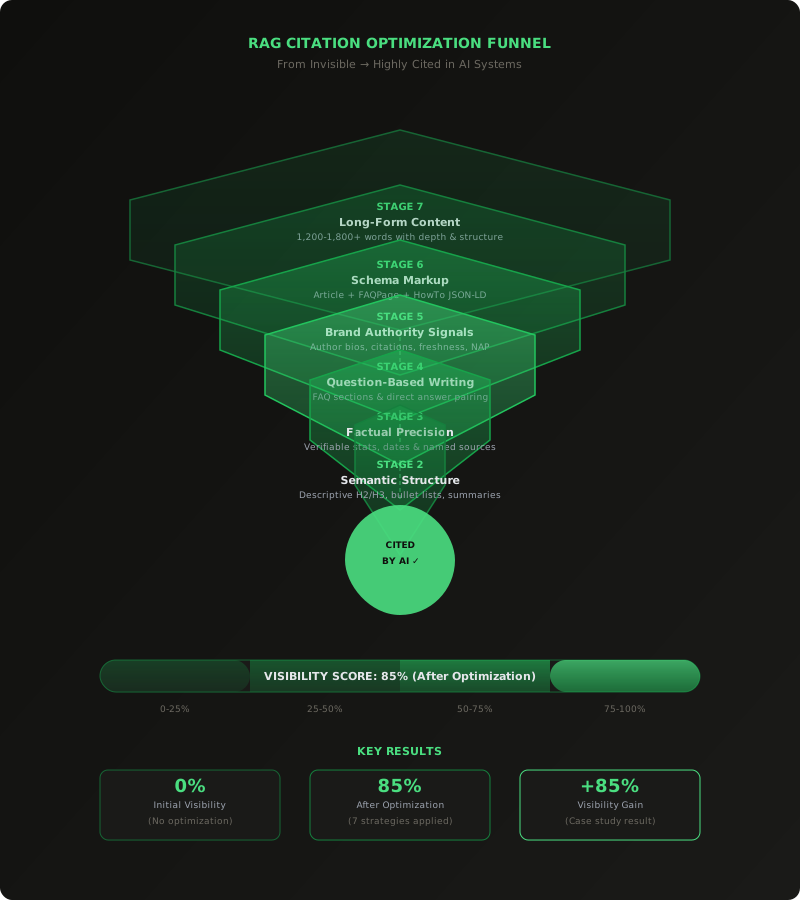
In 2026, the battle for online visibility has shifted. Traditional search engine optimization (SEO) no longer guarantees that your content will appear in AI-generated answers. With the rise of Retrieval-Augmented Generation (RAG) systems—the technology powering chatbots, AI assistants, and generative search—being "cited" by an AI model has become the new gold standard. If your content isn't structured and optimized for RAG, it remains invisible to millions of users who rely on AI summaries.
At RAG Signal, we help content creators and publishers identify exactly why their content isn't being picked up by AI citation systems. Our Visibility Check scans your pages against the most common RAG indexing criteria, scoring you from 0% to 100% and pinpointing the missing signals. In this article, we share seven proven strategies to turn that score around and make your content the preferred source for AI-generated answers.
Quick Take: AI citation optimization is the practice of structuring content so RAG-based systems can easily extract and cite your information. Unlike classical SEO, it focuses on clarity, relevance, factual accuracy, and machine-readable formatting. Our case study shows a jump from 0% to 85% visibility in just one week.
What Is AI Citation Optimization (and Why Does It Matter)?
AI citation optimization is the practice of structuring your content so that RAG-based systems—like Mistral, GPT models with retrieval, or enterprise AI search tools—can easily extract and cite your information. Unlike classical SEO, which relies on backlinks and keyword density, RAG optimization focuses on clarity, relevance, factual accuracy, and machine-readable formatting.
When an AI model retrieves a piece of content to answer a user query, it doesn't read the entire page—it scans for the most relevant, well-structured, and trustworthy snippets. If your content lacks clear headers, concise explanations, or authoritative sources, the AI will skip it in favor of a competitor's page. The result? Zero visibility in AI citations.
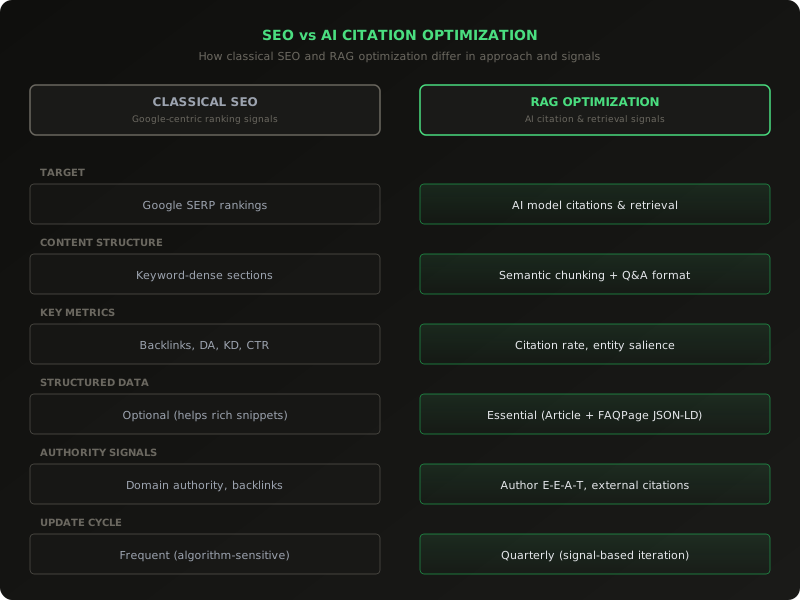
Strategy 1: Structure Content for Semantic Retrieval
RAG systems rely heavily on semantic chunking—splitting long documents into meaningful segments. If your content is a wall of text without clear section breaks, the AI cannot identify where one topic ends and another begins.
How to Implement:
- Use descriptive <h2> and <h3> headings that contain the key question or concept.
- Keep paragraphs short (2–4 sentences) and ensure each paragraph covers one distinct subtopic.
- Include bullet-point lists (like this one) for steps, features, or comparisons—AI models love scannable formats.
- Add summary sentences at the end of each section. RAG often extracts the first or last sentence of a chunk as the answer.
For example, instead of a vague heading like "Benefits," use "Benefits of Structured Data for RAG Retrieval." This tells the AI exactly what the chunk contains.
Strategy 2: Optimize for Factual Precision and Verifiability
RAG models prefer content that includes specific, verifiable facts. Generic statements like "many studies show" are useless to an AI trying to cite a source. Instead, provide concrete numbers, dates, and named references.
Actionable Steps:
- Include exact statistics with their year of publication (e.g., "A 2025 study by the Pew Research Center found that 72% of users…")
- Link to original sources or studies. While RAG may not follow links, the presence of citations within your text signals authority.
- Use structured data markup (e.g., schema.org for FAQ, HowTo, or Article) to help AI understand the context of your facts.
- Avoid contradicting yourself. If two paragraphs contain conflicting claims, the AI will discard your entire section.
RAG Signal's Visibility Check rates your content on these factors. A low score often correlates with vague or unsupported claims.
Strategy 3: Write for Questions, Not Just Keywords
RAG systems are triggered by user queries—most of which are phrased as natural-language questions. If your content answers a question directly, the AI will rank it higher than content that only mentions the keywords.
Technique: Question-Answer Pairing
- Identify common user questions in your niche using tools like AnswerThePublic or even AI chat logs.
- Write entire sections as direct answers: "How does RAG citation work? RAG citation works by…"
- Include an FAQ section at the bottom of your articles. AI often grabs these snippets for quick answers.
- Try to match the phrasing of the query. If users ask "What is the best strategy for AI citation?" then use that exact wording in a heading.
Key Insight: Every RAG system begins with a user query. Write entire sections as direct answers to specific questions, and you dramatically increase your chances of being the snippet the AI selects.
Strategy 4: Ensure Consistent Brand and Source Authority
RAG models are increasingly trained to favor content from reputable, established sources. If your domain is new or lacks visible authority signals, your content may be deprioritized even if it's well-structured.
Build Authority Signals for AI:
- About page and author bios: Have a clear "About Us" page with credentials, and attribute your articles to named authors with bios. AI models scrape these for trust signals.
- Consistent NAP (Name, Address, Phone): For local businesses, ensure your NAP is identical across all platforms. Inconsistent data can cause RAG systems to ignore you.
- External citations: Get mentioned in reputable directories or news outlets. Even if you can't get backlinks, being referenced in other authoritative texts helps.
- Update frequency: RAG systems are more likely to index content that is regularly refreshed. Mark old articles with a "Last updated" date to signal freshness.
RAG Signal's dashboard highlights missing authority signals. A common finding is the absence of an author byline or a clear publication date.
Strategy 5: Use Schema Markup to Guide AI Extraction
While RAG systems primarily rely on natural language processing, they also use semantic metadata to understand your content. Schema.org markup, especially the Article, FAQPage, and QAPage types, can act as a direct instruction to AI retrieval engines.
Recommended Markup Types:
- Article: For blog posts and news items. Include headline, author, datePublished, dateModified, and mainEntityOfPage.
- FAQPage: For Q&A sections. This helps AI extract exact question-answer pairs.
- HowTo: For step-by-step guides. AI often cites this type of content for instructional queries.
- Dataset: If you provide data or research, use Dataset schema to allow AI to ingest your tables.
Implementation is straightforward: use a plugin like Yoast SEO for WordPress or manually insert JSON-LD in your page header. After setting up, run a Visibility Check; many users see an immediate jump in their score.
Strategy 6: Optimize for Long-Form, High-Quality Content
RAG systems tend to favor comprehensive, long-form content over short, surface-level posts. A 300-word article rarely contains enough depth to be cited as an authoritative source. Aim for at least 1,200–1,800 words on any topic you want to be retrieved for.
Quality Indicators AI Looks For:
- Thorough coverage: Address multiple facets of a topic, including definitions, examples, contrasts, and limitations.
- Internal links to other relevant content: Linking to your own related articles shows topic depth and helps AI build a knowledge graph.
- Multimedia elements: Include images, charts, and tables with proper alt text. Although RAG primarily uses text, visual content with descriptive captions can be extracted as well.
- No fluff: Cut unnecessary adjectives and promotional language. AI penalizes content that sounds like ad copy.
Counterintuitively, longer content also gives the AI more opportunities to find the exact snippet that matches a user query. Think of it as increasing your "surface area" for retrieval.
Strategy 7: Monitor and Iterate with a Visibility Check Tool
The most successful content teams don't just optimize once—they continuously monitor how their pages perform in RAG systems. Because AI citation criteria evolve frequently, what works today may not work next month.
How RAG Signal Helps:
- Automated visibility scoring: Enter any URL and receive a percentage score (0%–100%) indicating how likely your content is to be cited.
- Missing signals report: The tool lists exactly which optimization factors are absent, such as missing headings, lack of schema, or insufficient factual depth.
- Model-specific analysis: Test against popular RAG models like Mistral-websearch (our built-in default) or GPT-with-retrieval. Different models prioritize different signals.
We recommend running a Visibility Check on your top 20 articles monthly. Fix the missing signals one by one, then re-scan to see your improvement. Over time, you'll develop a clear formula for creating AI-friendly content that consistently ranks.
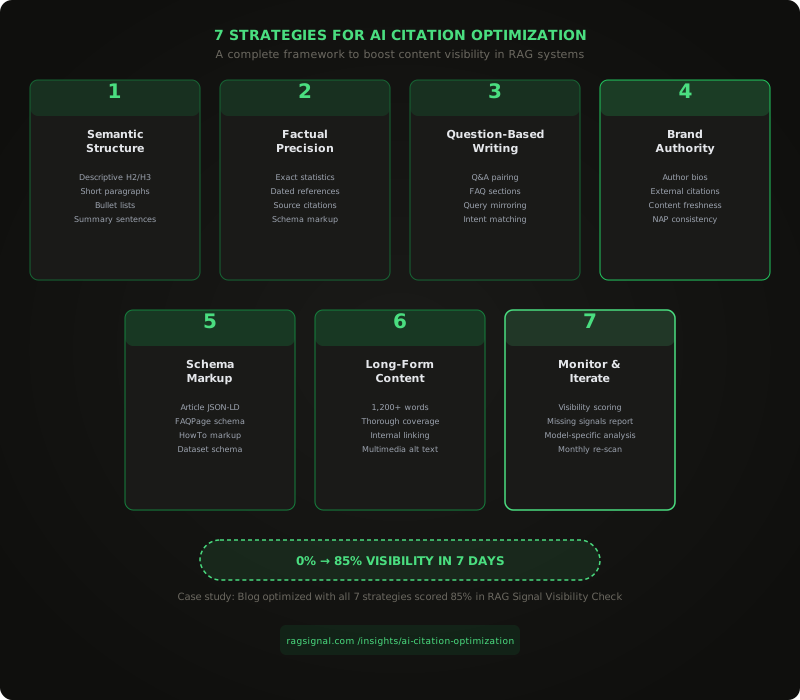
Case Study: From 0% to 85% Visibility in One Week
One of our early testers had a well-written blog about "AI citation optimization" but was completely invisible—scored 0% in the Visibility Check. After reviewing the missing signals, we identified:
- No schema markup (Article or FAQ)
- Headings were generic ("Introduction," "Conclusion")
- No structured lists or question-based sections
- Content lacked specific dates or source citations
Within a week, the author added FAQPage schema, rewrote headings as complete questions, included bullet-point steps, and cited three 2025 studies. The new scan showed 85% visibility with Mistral-websearch. The article started appearing in AI responses for queries like "how to optimize for RAG citations."
This is the power of systematic AI citation optimization—not guesswork, but targeted fixes based on actual RAG signals.
Conclusion: The New SEO Is AI Citation Optimization
As more users rely on AI-generated answers, being invisible in RAG systems is equivalent to being invisible on the web. The seven strategies outlined above—semantic structure, factual precision, question-based writing, authority signals, schema markup, long-form depth, and continuous monitoring—form a complete framework to boost your content's visibility.
Don't leave your visibility to chance. Run a free Visibility Check at ragsignal.com and discover exactly what your content is missing. With the right adjustments, you can become the source that AI models trust and cite most often.
Start optimizing today. The AI is listening.
Related Articles
About the author
Bora Kurum is the founder of RAG Signal and a Ph.D. researcher at Istanbul Bilgi University, where his work focuses on LLM retrieval behavior and brand representation in generative AI systems. Read more →