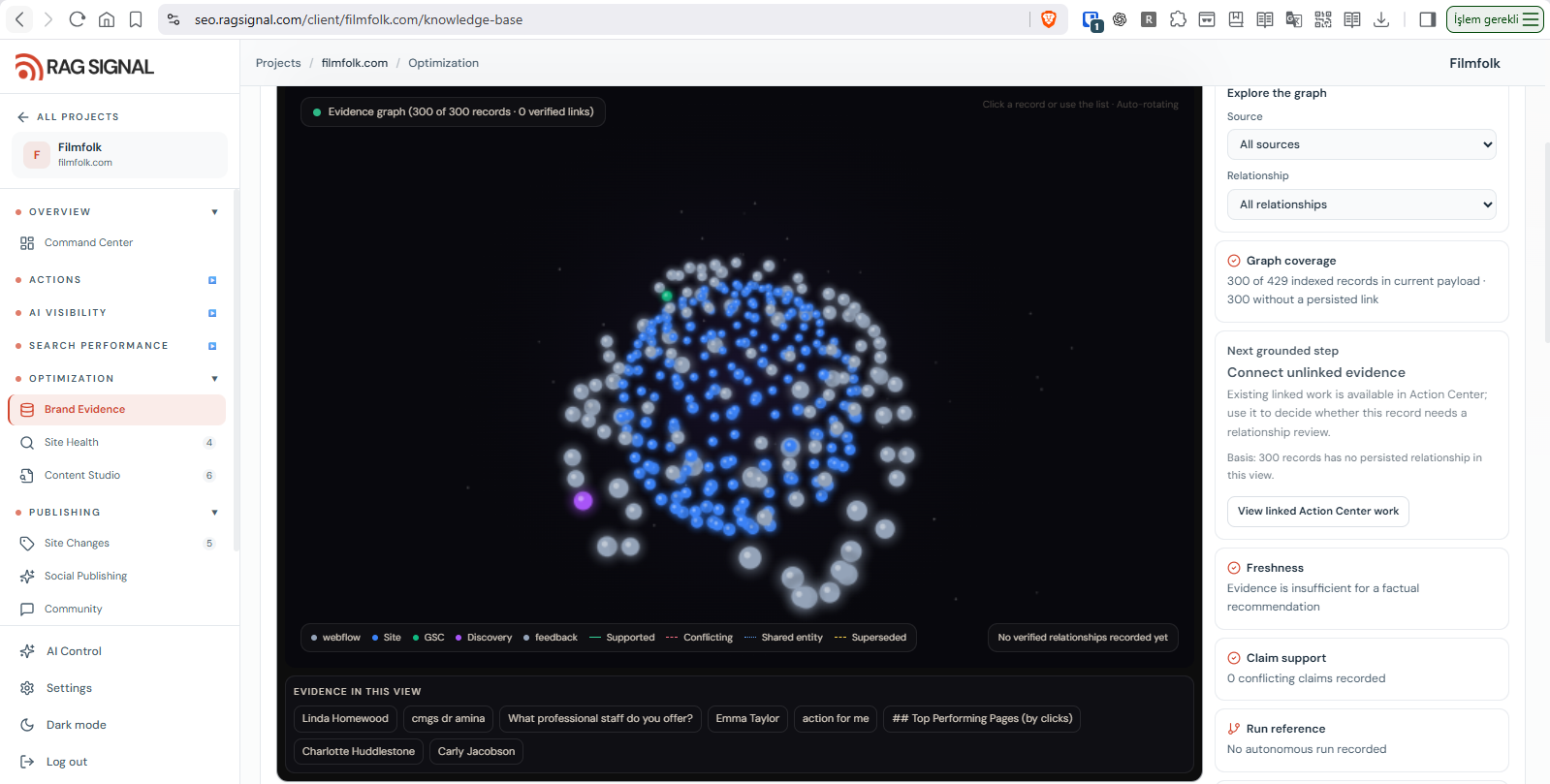
Evidence graph
We connect the evidence behind Brand Memory.
Sources, entities, and verifiable claims are organised into one working context for our team to evaluate.

We make your brand easier for AI systems to retrieve, trust and cite — one managed program across ChatGPT, Perplexity, Gemini and Claude, run by our team.
Free baseline audit. No commitment. Delivered in 5 business days.
The RAG Signal team uses the system we build to collect evidence, set priorities, direct technical work, and report the result.
Sources, entities, and verifiable claims are organised into one working context for our team to evaluate.
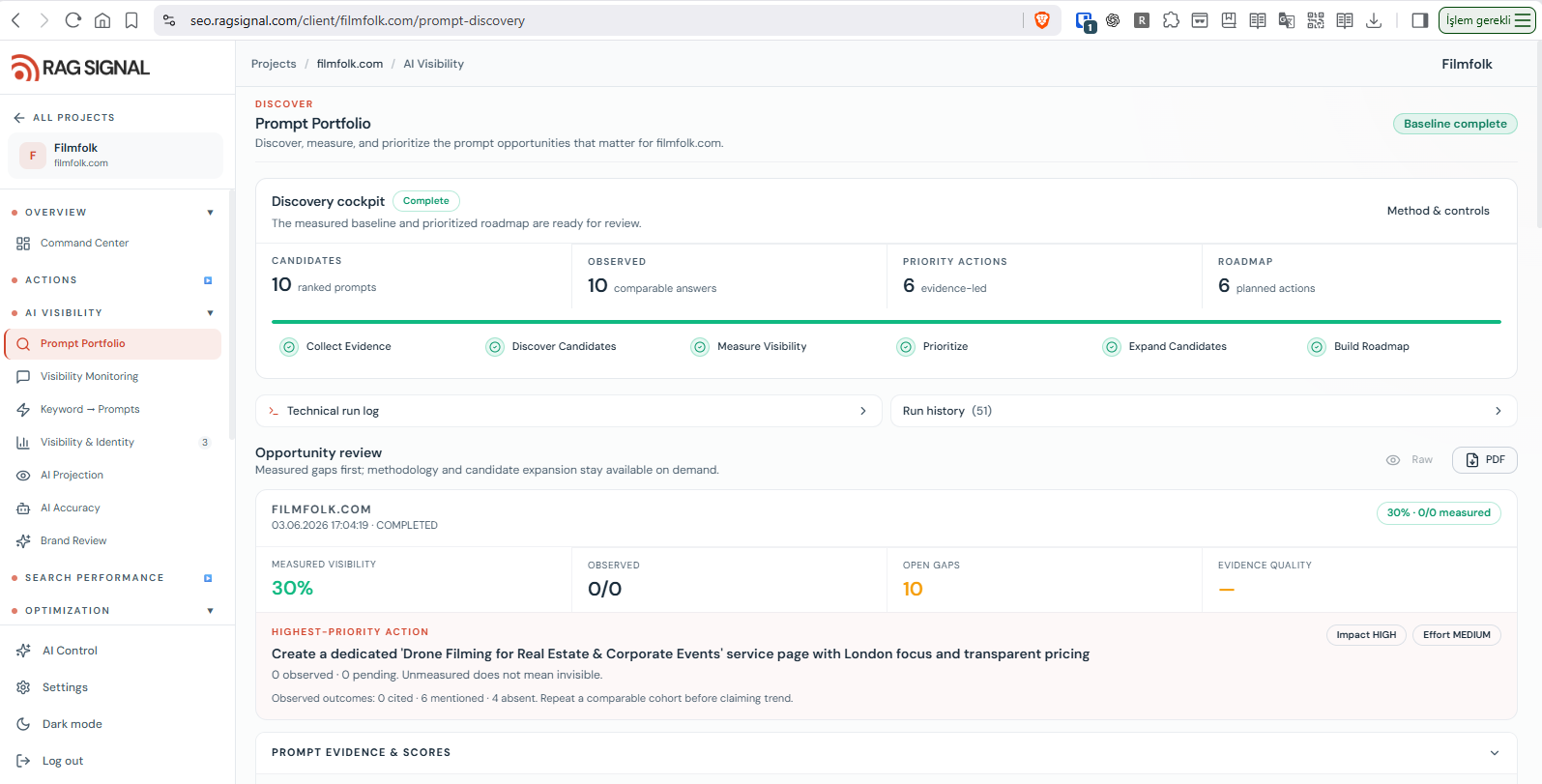
Evidence, candidates, visibility measurement, and the roadmap move through one team-operated cycle.
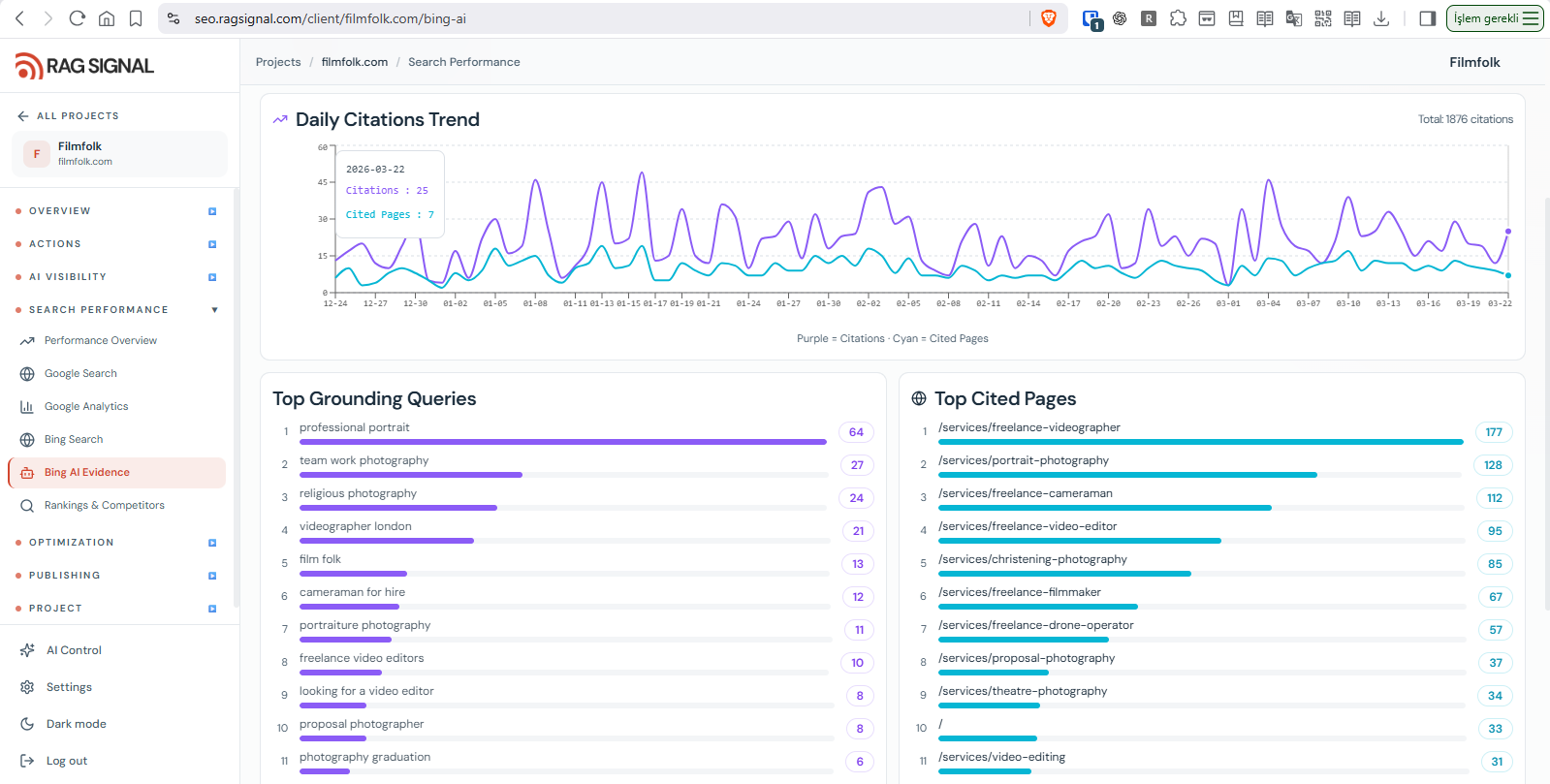
Our team interprets model, prompt, and source movement so you receive the context needed for a decision.
These screens show the environment used during client work. We provide expert-led delivery — not a dashboard you are expected to operate.
Engagement options
We put half our fee on the line.
Start with €1,499. The remaining €1,499 is due only when we meet the citation targets we agree together at the outset.
Citation Baseline Audit
No cost
PDF report within 5 business days. No commitment, no credit card.
90-Day Visibility Sprint
€1,499 upfront + €1,499
Success fee — due only when the citation targets agreed before work begins are met.
The €1,499 upfront payment funds the agreed foundation work.
AI Presence Retainer
€1,999/month
Ongoing reinforcement after Sprint completion. Month-to-month, cancel anytime.
From corporates and universities to fast-growing brands and agencies — 24+ teams have worked with us.
























Logos are the property of their respective owners.

"The audit was genuinely eye-opening and the implementation was clean and professional. We went from being completely absent in AI recommendations to being the first brand named."
— Andrew Cussens, Founder, Filmfolk, London · Engagement led by Bora Kurum
Buyers increasingly ask AI systems for recommendations — and AI systems retrieve and synthesize information differently from traditional search. A brand can rank highly on Google but remain completely absent from AI-generated answers.
THEN
NOW
AI-powered search compresses the entire journey into a single answer.
If your brand isn't retrieved, the buyer never encounters it.
Every AI answer is a retrieval decision. Based on observable citation patterns, models weigh signals such as entity density, source trust, citation frequency and temporal freshness when selecting which sources to cite. Our five-step methodology systematically improves your brand's retrieval readiness across these dimensions.
Identify high-value prompts, entities, competitors and citation patterns across all four models.
→ Discovered 63 buyer prompts
Create structured Brand Memory: entity definitions, factual assertions, and citation anchors AI systems need.
→ Brand Memory: 42 entity assertions, 12 citation anchors
Strengthen trust, consistency, authority and entity relationships using published scoring algorithms.
→ Scored signals, identified 14 high-impact anchors
Deploy per model: llms.txt for Claude, structured data for Perplexity, entity-rich content for ChatGPT.
→ Deployed across ChatGPT, Claude, Perplexity, Gemini
Track Citation Delta at 30/60/90 days. Binary, auditable: cited or not cited. No SEO guesswork.
→ Citation Delta tracking at 30/60/90 days
That's why we're called RAG Signal. We engineer the retrieval signals that make AI models cite your brand. Measured. Engineered. Monitored.
Six deliverables. One system. Every step measured, every outcome auditable.
Baseline citation check across 4 LLMs, competitor citation map, actionable gap report.
→ Know exactly where you stand — PDF in 5 business days.
Structured Brand Memory: entity definitions, factual assertions, relationship maps.
→ Your brand becomes the obvious retrieval target across all models.
Citation Delta at 30/60/90 days. Model update alerts within 48h. Competitive tracking.
→ Never blindsided by a model update — know what changed and respond.
Also included in every program
Discover the real questions where buyers compare providers — before they know your brand name.
→ 63 prompts mapped for Filmfolk — only 4 were branded keywords.
Centralized knowledge infrastructure that models treat as authoritative.
→ Consistent brand representation regardless of which model or prompt.
Entity-optimized content, JSON-LD, llms.txt, and Schema markup deployed across your site.
→ Your website works for both Google rankings and AI retrieval.
Traditional SEO remains important, but AI recommendation systems introduce additional retrieval, entity and citation layers that SEO tools cannot address.
Google SERP
RAG Signal
Straight answers from the engineers building it.
AI visibility means your brand appears and is cited in AI model responses when users ask relevant prompts. It's measured by Citation Rate — the percentage of relevant buyer prompts where the model mentions your brand by name. Unlike SEO, which measures where your website appears on Google, AI visibility measures whether AI models know and recommend your brand.
SEO measures where your website appears on Google search results. Citation Rate measures whether AI models mention your brand by name in their responses. They're complementary: SEO drives click traffic, Citation Rate drives AI recommendation traffic. A brand can rank #1 on Google and still be invisible in AI — which is exactly what happened with Filmfolk.
We currently track ChatGPT, Claude, Perplexity, and Gemini — the four models your buyers actually use. Grok and DeepSeek are coming soon. Your Brand Memory deploys across all models simultaneously, not optimized for one at the expense of others.
The 90-Day Sprint delivers measurable citation lift by Day 30, with full results at Day 90. In the Filmfolk case study, ChatGPT went from 0% to 42% by Day 30 and 84% by Day 90. The baseline audit delivers a complete report within 5 business days.
No. AI platforms (ChatGPT, Claude, Gemini, Perplexity) and their proprietary algorithms make the final decision about which sources to cite and how to surface information. We do not control these algorithms, and no one can guarantee specific placement. What we do is provide the strongest possible foundation: structured Brand Memory, systematic content engineering, and continuous monitoring — all the technical groundwork that makes citations more likely.
Brand Memory is the structured knowledge representation of your brand that AI models retrieve when processing prompts. It comprises entity definitions, factual assertions, relationship maps, and citation anchors that models treat as authoritative. Think of it as the knowledge graph that makes your brand the obvious retrieval target. Learn more →
The 90-Day Visibility Sprint is a one-time engagement that builds your Brand Memory from scratch and achieves initial citation targets. The AI Presence Retainer is ongoing — it maintains and grows your citation share through continuous reinforcement, model update monitoring, and prompt expansion. Most clients start with the Sprint and move to the Retainer after hitting targets.
One audit shows you exactly where you stand — across every major AI model your buyers use.
Talk to Us →